Balancing Growth and Sustainability Through Policy Reform
This blog examines how public policy reform can reconcile economic growth with sustainability rather than treating them as competing goals. It explores the limitations of growth-focused development models and highlights the long-term social and environmental costs of unsustainable policies. The article argues for evidence-based, integrated, and inclusive policy reforms that align economic ambition with ecological responsibility and social equity. Emphasizing institutional coordination, public participation, and long-term resilience, the blog concludes that sustainable growth is not only possible but essential for enduring prosperity. Policy reform, it argues, is the key to ensuring that growth strengthens rather than undermines sustainable development.
4/21/20253 min read
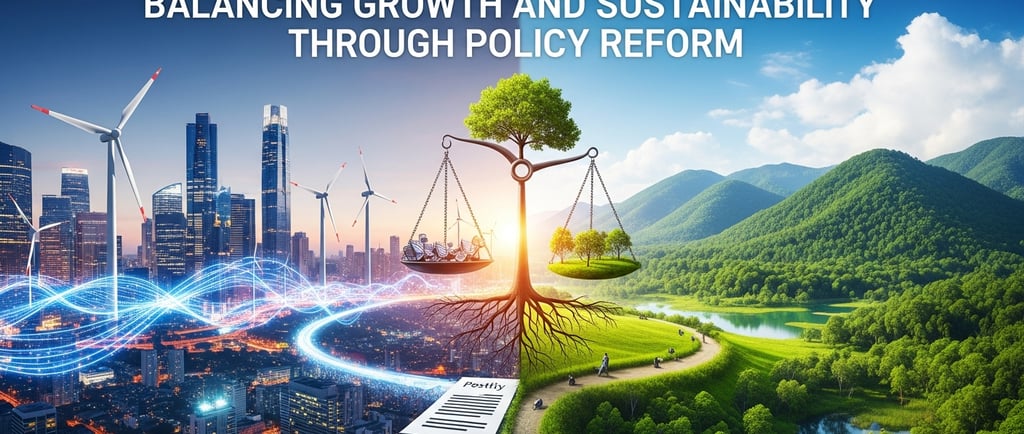
Economic growth has long been the central objective of public policy, widely regarded as the primary pathway to prosperity, employment, and improved living standards. However, as environmental degradation, social inequality, and resource scarcity intensify, it has become increasingly clear that growth pursued without regard for sustainability carries significant long-term costs. The challenge for policymakers today is not choosing between growth and sustainability, but reforming policies in ways that allow both to reinforce rather than undermine one another.
Growth Without Limits: Lessons from Policy Experience
For decades, development policies across the world prioritized rapid economic expansion, often measured narrowly through indicators such as GDP growth and industrial output. While this approach delivered material progress in many contexts, it also generated unintended consequences. Environmental damage, widening social disparities, and institutional strain emerged as persistent side effects of growth-focused strategies that discounted long-term sustainability.
Policy experience has shown that growth driven by excessive resource extraction, environmental neglect, or social exclusion is inherently fragile. Short-term economic gains can quickly be offset by long-term losses in productivity, public health, and social cohesion. Pollution, climate-related disasters, and ecosystem degradation impose costs that ultimately slow growth and increase public expenditure. Similarly, growth that fails to generate broad-based opportunities can fuel inequality and social unrest, undermining political and economic stability.
These outcomes reveal a fundamental policy lesson: growth and sustainability cannot be treated as separate or competing objectives. When sustainability is ignored, growth becomes self-defeating. When growth is neglected, sustainability efforts lack the economic foundation needed for long-term viability. Policy reform must therefore move beyond outdated trade-offs and embrace integrated approaches that recognize their interdependence.
Reframing Policy Choices for Long-Term Prosperity
Balancing growth and sustainability requires a shift in how policymakers conceptualize progress and design interventions. The first step in this reform process is redefining development objectives. Economic expansion remains important, but it must be pursued alongside goals related to environmental protection, social equity, and institutional resilience. Policy frameworks should reflect a broader understanding of prosperity that values well-being, ecological balance, and long-term security.
Evidence-based policy-making is central to this shift. Data and research allow policymakers to assess the environmental and social impacts of economic activities, identify sustainable growth pathways, and evaluate policy trade-offs. For example, research can demonstrate how investments in renewable energy generate employment while reducing emissions, or how sustainable agriculture enhances food security and rural livelihoods. Such evidence challenges the assumption that sustainability constrains growth and instead highlights opportunities for mutually reinforcing outcomes.
Policy reform must also address structural incentives. Many existing policies implicitly reward unsustainable behavior through subsidies, regulatory loopholes, or weak enforcement. Reforming these incentives—by aligning taxation, regulation, and public investment with sustainability goals—can redirect economic activity toward more resilient and inclusive models. This includes promoting innovation, supporting green industries, and encouraging responsible consumption and production patterns.
Institutional coordination is another critical element. Growth and sustainability objectives often fall under different ministries or agencies, leading to fragmented decision-making. Integrated policy reform requires coordination across economic, environmental, and social sectors to ensure coherence and consistency. Mechanisms for inter-agency collaboration, shared planning frameworks, and joint evaluation processes help align policy goals and reduce contradictions.
Public participation also plays a vital role in balancing growth and sustainability. Communities experience the impacts of development policies firsthand and can offer valuable insights into local conditions and priorities. Inclusive policy processes enhance legitimacy and help ensure that growth strategies do not disproportionately burden vulnerable groups. Engaging citizens, civil society, and the private sector fosters shared responsibility for sustainable outcomes.
Policy Reform as a Pathway to Resilient Futures
Ultimately, balancing growth and sustainability is not a one-time policy adjustment but an ongoing process of reform, learning, and adaptation. Economic and environmental conditions evolve, technologies advance, and social expectations change. Policy frameworks must therefore be flexible and responsive, capable of incorporating new evidence and adjusting to emerging challenges.
Long-term resilience should be a guiding principle of policy reform. Resilient economies are better able to withstand shocks, whether from climate events, market disruptions, or public health crises. Sustainability-oriented policies contribute to resilience by reducing vulnerability, diversifying economic bases, and preserving natural systems that support livelihoods and well-being.
Ethical responsibility also underpins the case for balanced policy reform. Decisions made today shape opportunities for future generations. Policies that prioritize immediate growth at the expense of environmental integrity or social cohesion effectively transfer costs to those who have no voice in current decision-making. Incorporating intergenerational considerations into policy design reinforces the moral and practical imperative for sustainability.
Policy research institutions have a crucial role to play in this transition. By generating evidence, evaluating reforms, and facilitating dialogue, they support informed decision-making and accountability. Research helps policymakers navigate complexity, challenge false trade-offs, and identify pathways that reconcile economic ambition with ecological and social responsibility.
Balancing growth and sustainability through policy reform is one of the defining governance challenges of our time. Success depends not on abandoning growth, but on redefining it—ensuring that economic progress enhances rather than erodes the foundations of long-term prosperity. Through coherent, evidence-based, and inclusive reforms, public policy can align growth with sustainability and build futures that are both prosperous and resilient.