
From Research to Reform: How Policy Studies Shape Governance
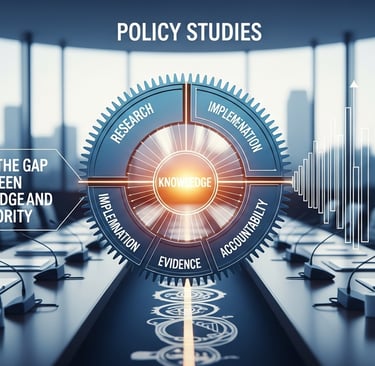
This blog explores the critical role of policy studies in shaping effective and accountable governance. It explains how research serves as the foundation for policy ideas, informs decision-making across formulation, implementation, and evaluation, and strengthens public discourse. The article highlights the importance of evidence in addressing complex, interconnected governance challenges while promoting transparency, accountability, and long-term thinking. It also examines the role of research institutions in bridging the gap between knowledge and authority. Ultimately, the blog argues that embedding research within governance processes is essential for achieving sustainable, inclusive, and informed policy reform in contemporary societies.
2/2/20253 min read

Ideas Before Institutions: Why Research Comes First
Public policy is often perceived as the product of political negotiation, administrative authority, or legislative power. Yet, long before policies take the form of laws, regulations, or programs, they originate as ideas—ideas about social problems, economic priorities, institutional responsibilities, and public needs. Policy studies provide the intellectual foundation upon which these ideas are examined, refined, and tested. In this sense, research is not an accessory to governance; it is its starting point.
In contemporary governance environments marked by complexity and uncertainty, intuition and tradition alone are no longer sufficient. Governments face interconnected challenges such as economic volatility, social inequality, demographic change, climate risks, and technological disruption. These issues cannot be effectively addressed through fragmented or reactive policy responses. Policy studies enable decision-makers to understand the structural causes of problems, identify patterns and trends, and evaluate the likely consequences of different policy options.
Research also plays a critical role in challenging assumptions. Many governance failures stem not from a lack of intent but from flawed understanding of social realities. Policy studies draw on empirical data, field research, and comparative analysis to question dominant narratives and reveal gaps between policy design and lived experience. By doing so, they help policymakers move beyond surface-level solutions toward deeper, more sustainable reforms.
Moreover, policy research encourages long-term thinking. Electoral cycles and political pressures often incentivize short-term policy decisions, while societal challenges require sustained and strategic responses. Policy studies provide historical context and future-oriented analysis that help governments anticipate risks, assess trade-offs, and design policies with enduring impact. In this way, research helps align governance with broader public interest rather than immediate political gain.
When Evidence Meets Authority: Research in the Practice of Governance
The transformative power of policy studies becomes evident when research findings are integrated into governance processes. This integration occurs at multiple stages—problem identification, policy formulation, implementation, and evaluation. At each stage, research contributes to more informed, transparent, and accountable decision-making.
During policy formulation, research helps clarify the nature and scale of problems. Through data analysis and diagnostics, policymakers can distinguish between symptoms and root causes. For example, addressing unemployment requires understanding labor market dynamics, education systems, regional disparities, and technological change. Policy studies provide this multidimensional perspective, enabling targeted and effective interventions.
In the implementation phase, research supports institutional design and administrative efficiency. Studies on public administration, regulatory frameworks, and service delivery systems help governments understand how policies function on the ground. Without such insights, well-intentioned policies may fail due to weak capacity, bureaucratic bottlenecks, or misaligned incentives. Policy studies identify these risks in advance and offer evidence-based strategies to mitigate them.
Evaluation is another critical area where policy research shapes governance. Monitoring and evaluation frameworks allow governments to assess whether policies are achieving intended outcomes. Research-based evaluation promotes learning by identifying what works, what does not, and under what conditions. This iterative process strengthens governance by encouraging adaptation rather than rigid adherence to ineffective policies.
Beyond internal government processes, policy studies also influence governance by shaping public discourse. In democratic systems, governance is not only exercised through institutions but also through debate, participation, and accountability. Research-based analysis enriches public discussion by providing factual grounding and analytical clarity. It counters misinformation, reduces ideological polarization, and fosters more constructive engagement between citizens, media, and policymakers.
Policy research institutions play a crucial intermediary role in this process. By translating academic research into accessible policy insights, they bridge the gap between knowledge producers and decision-makers. They convene dialogues, publish policy briefs, and facilitate collaboration across sectors. In doing so, they help ensure that governance decisions are informed not only by political considerations but also by evidence and expertise.
From Insight to Impact: Building a Culture of Research-Informed Reform
While the value of policy studies is widely acknowledged, the transition from research to reform remains a complex and uneven process. Political constraints, institutional inertia, limited research capacity, and resistance to change often hinder the uptake of evidence. Nevertheless, the growing emphasis on evidence-based policy-making reflects an important shift in governance culture.
Building a culture of research-informed reform requires commitment at multiple levels. Governments must invest in data systems, research capacity, and analytical skills within public institutions. Policymakers must be willing to engage with evidence, even when it challenges established practices or political preferences. Research institutions must prioritize relevance and accessibility, ensuring that their work responds to real policy needs.
Equally important is the recognition that evidence alone does not dictate policy choices. Policy-making involves values, ethics, and societal priorities that cannot be reduced to data. Research should inform judgment, not replace it. Effective governance balances empirical evidence with democratic deliberation, contextual understanding, and social responsibility.
When this balance is achieved, policy studies become powerful drivers of reform. Research-informed policies are more likely to be inclusive, resilient, and adaptive. They respond to complexity rather than oversimplifying it. They encourage accountability by making assumptions explicit and outcomes measurable. Most importantly, they enhance public trust by demonstrating that decisions are based on knowledge rather than arbitrariness.
As societies confront increasingly complex challenges, the role of policy studies in shaping governance will only grow. From climate policy to social welfare, from digital regulation to institutional reform, the path from research to reform is essential for meaningful progress. Strengthening this pathway is not merely an academic exercise; it is a prerequisite for effective, equitable, and sustainable governance in the modern world.