
How Research Institutions Can Drive Long-Term Social Change
This blog explores how research institutions can drive long-term social change by shaping ideas, influencing policy, and sustaining public dialogue over time. It examines how knowledge production reframes social problems, how engagement with policy and civil society translates insight into action, and how capacity building spreads research-informed values across generations. The article emphasizes credibility, ethical responsibility, and institutional resilience as key to enduring impact. Concluding that meaningful social change is cumulative rather than immediate, the blog argues that research institutions play a vital role in guiding societies toward more informed, inclusive, and sustainable futures through persistent inquiry and engagement.
11/24/20254 min read

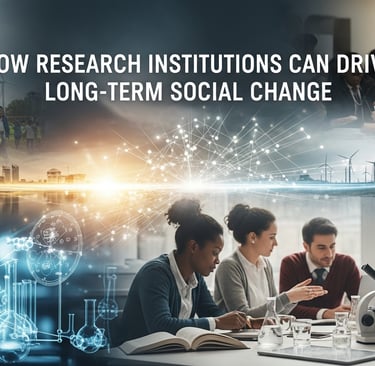
Long-term social change rarely occurs through sudden shifts or isolated interventions. It unfolds gradually, shaped by ideas, institutions, and sustained engagement with societal challenges. Research institutions occupy a unique position in this process. By producing knowledge, informing public debate, and influencing policy over time, they contribute to transformations that extend far beyond immediate political cycles. Understanding how research institutions can drive long-term social change is essential for appreciating their role not merely as centers of analysis, but as agents of societal progress.
Where Ideas Take Root: Knowledge as the Seed of Change
At the foundation of long-term social change lies knowledge. Research institutions contribute by identifying problems, questioning assumptions, and generating evidence that challenges prevailing norms. Social change often begins when new ways of understanding the world gain legitimacy—when evidence reshapes how issues such as inequality, governance, public health, or environmental sustainability are perceived.
Through rigorous research, institutions illuminate structural causes of social problems that may otherwise be attributed to individual failure or circumstance. By reframing issues in systemic terms, research shifts public discourse and opens space for collective solutions. For example, research that documents patterns of exclusion or unequal access to opportunity helps move debates beyond anecdote toward structural reform. Over time, such reframing influences how societies define fairness, responsibility, and public obligation.
Research institutions also preserve institutional memory. Social change requires continuity of knowledge across generations, political transitions, and shifting priorities. By maintaining archives, datasets, and analytical frameworks, research institutions ensure that lessons learned are not lost. This continuity allows societies to build on past experience rather than repeatedly reinventing responses to recurring challenges.
Importantly, the impact of research on social change is often indirect. Ideas may take years to influence policy or practice, circulating through academic debate, public discourse, and institutional learning. Research institutions therefore contribute to long-term change by sustaining inquiry and dialogue even when immediate impact is not visible. Their value lies in persistence as much as in innovation.
From Insight to Influence: Shaping Policy, Practice, and Public Debate
While ideas are foundational, long-term social change depends on influence. Research institutions exert influence by engaging with policy processes, civil society, and public discourse. This engagement transforms knowledge into action over time, gradually reshaping institutions and social norms.
One pathway of influence is policy engagement. Research institutions inform legislation, program design, and institutional reform by providing evidence-based analysis. Even when research does not lead directly to policy adoption, it shapes the range of options considered legitimate. Over time, this cumulative influence contributes to more informed and equitable governance. Policies addressing education, health, social protection, or environmental management often reflect decades of research-driven learning rather than single studies.
Another pathway is capacity building. Research institutions train students, policymakers, practitioners, and civil society actors in analytical thinking and evidence use. These individuals carry research-informed perspectives into diverse roles across society. The diffusion of skills and values through education and training is a powerful driver of long-term change, embedding research literacy within institutions and communities.
Public engagement is equally significant. Research institutions contribute to social change by participating in public discourse—through publications, media engagement, conferences, and community dialogue. By communicating evidence clearly and responsibly, they help counter misinformation and enrich democratic debate. Over time, such engagement raises the overall quality of public conversation and strengthens the link between knowledge and citizenship.
Partnerships amplify impact. Collaboration with government agencies, non-governmental organizations, and international bodies allows research institutions to embed evidence within broader social initiatives. These partnerships align research with practical action while preserving analytical independence. When sustained over time, they create ecosystems in which knowledge, practice, and policy reinforce one another.
Crucially, influence depends on credibility. Research institutions must uphold integrity, transparency, and methodological rigor to maintain trust. Long-term social change requires institutions that are seen as reliable and independent sources of knowledge. Credibility ensures that research continues to inform debate even when findings challenge powerful interests or entrenched norms.
Sustaining Change Across Time and Generations
The most profound contributions of research institutions to social change emerge over extended time horizons. Social norms, institutional practices, and governance frameworks evolve gradually, shaped by cumulative learning rather than immediate results. Research institutions sustain this process by remaining committed to long-term inquiry and reflection.
Adaptability is central to sustaining impact. As social conditions change, research agendas must evolve to remain relevant. Institutions that periodically reassess priorities and methods are better positioned to address emerging challenges without abandoning foundational commitments. This balance between continuity and adaptation enables research institutions to remain effective drivers of change.
Ethical responsibility also shapes long-term impact. Research institutions influence not only what is known, but how knowledge is used. Attention to inclusion, equity, and social justice ensures that research-driven change benefits diverse communities rather than reinforcing existing inequalities. By engaging marginalized voices and addressing power dynamics, research institutions contribute to more just and inclusive social transformation.
Institutional resilience matters as well. Long-term social change requires organizations capable of withstanding political pressure, funding fluctuations, and shifting public attention. Strong governance, diversified support, and clear mission help research institutions maintain independence and continuity. Resilient institutions are better equipped to pursue long-term goals even when short-term incentives favor immediacy.
Ultimately, research institutions drive long-term social change by shaping how societies understand themselves and their challenges. They influence the questions that are asked, the solutions that are imagined, and the values that guide collective action. While their impact may not always be immediate or visible, it is enduring. Through sustained knowledge production, engagement, and ethical commitment, research institutions help societies evolve toward more informed, equitable, and resilient futures.