
Making Policy Research Accessible to the Public
This blog explores why making policy research accessible to the public is essential for democratic governance and effective policy outcomes. It examines how inaccessible language, formats, and dissemination limit public understanding and trust, while clear and transparent communication strengthens accountability and inclusion. The article discusses strategies for translating research without oversimplification, including clear language, contextualization, visual tools, and digital platforms. Emphasizing institutional responsibility, it argues that accessible research empowers citizens, improves public discourse, and enhances policy legitimacy. Ultimately, the blog presents open and understandable policy research as a public good vital to informed participation and resilient democratic systems.
10/27/20253 min read

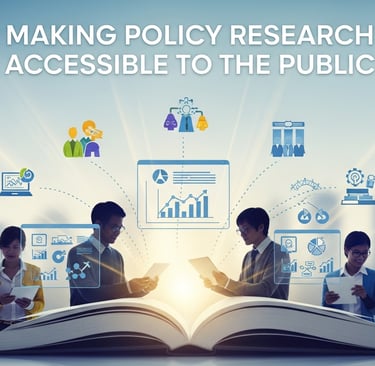
Policy research plays a decisive role in shaping laws, programs, and governance frameworks that affect everyday life. Yet, despite its importance, much policy research remains inaccessible to the very public it is meant to serve. Dense language, technical formats, and limited dissemination often create a divide between knowledge producers and citizens. In democratic societies, closing this gap is not simply a matter of communication efficiency; it is a matter of legitimacy, accountability, and inclusive governance.
Knowledge Behind Closed Doors: Why Accessibility Matters
When policy research is inaccessible, its benefits are unevenly distributed. Policymakers, experts, and institutions may have access to data and analysis, while citizens remain excluded from understanding the evidence behind public decisions. This imbalance can weaken trust and fuel perceptions that policy-making is opaque or elitist. Accessibility matters because informed citizens are better positioned to engage with governance processes, evaluate policy choices, and hold institutions accountable.
Inaccessible research also limits impact. Rigorous analysis that remains confined to academic journals or technical reports risks being overlooked in public debate. Policies influenced by such research may face resistance if citizens do not understand their rationale or implications. Making research accessible helps ensure that evidence informs not only decisions but also public understanding and acceptance.
Accessibility is particularly important in contexts marked by misinformation and polarized discourse. When credible research is difficult to access or understand, simplified or misleading narratives can dominate public conversation. Clear and accessible policy research provides an alternative grounded in evidence, enabling citizens to navigate complex issues with greater confidence. In this way, accessibility strengthens the quality of public discourse and democratic participation.
Importantly, accessibility does not mean oversimplification. It means clarity without distortion and openness without loss of rigor. Translating research for public audiences requires skill, intentionality, and respect for readers’ intelligence. When done well, accessible research empowers citizens without compromising analytical depth.
From Analysis to Understanding: Translating Research for Wider Audiences
Making policy research accessible involves rethinking how knowledge is communicated. Traditional academic formats prioritize precision and peer validation, often at the expense of readability. Public-facing research must adopt complementary formats that prioritize clarity, relevance, and engagement. Policy briefs, summaries, infographics, and explainer articles are tools that help bridge this gap.
Language plays a central role in accessibility. Technical jargon, while useful among specialists, can alienate broader audiences. Clear language that explains concepts, methods, and findings enables readers to grasp key insights without specialized training. This does not require abandoning complexity, but rather structuring information in ways that guide understanding.
Contextualization is equally important. Policy research gains meaning when connected to everyday experiences and social realities. Explaining why a policy issue matters, who it affects, and how research findings relate to lived experience helps readers see relevance. Such framing transforms abstract analysis into relatable insight, fostering engagement and interest.
Visual communication enhances accessibility by presenting information in intuitive ways. Charts, maps, and diagrams can convey patterns and comparisons more effectively than text alone. However, visuals must be designed carefully to avoid misinterpretation. Accuracy and transparency remain essential, even as presentation becomes more engaging.
Digital platforms have expanded opportunities for accessibility. Websites, social media, podcasts, and videos allow research to reach diverse audiences. These platforms also enable interaction, allowing readers to ask questions and share perspectives. However, digital accessibility requires attention to inclusivity, including language diversity, disability access, and digital literacy. Without such consideration, efforts to broaden access may inadvertently exclude some groups.
Crucially, making research accessible requires institutional commitment. Researchers must be supported and incentivized to engage with public audiences. Communication skills, collaboration with editors or communicators, and time for public engagement should be valued alongside traditional academic outputs. Accessibility should be seen as an integral part of research impact rather than an optional add-on.
Strengthening Democracy Through Open Knowledge
Accessible policy research contributes directly to democratic strength. When citizens understand the evidence behind policy decisions, they are more likely to trust institutions and engage constructively with governance processes. Transparency in research communication reinforces accountability by allowing the public to scrutinize both data and interpretation.
Accessible research also enhances inclusivity. Marginalized communities often experience the greatest impacts of public policy yet have the least access to policy knowledge. Making research understandable and widely available helps reduce this imbalance, enabling more equitable participation in policy debates. Inclusive access to knowledge supports more representative and responsive governance.
For policymakers, public accessibility can be an asset rather than a liability. Policies that are informed by transparent research and communicated clearly are more likely to gain public support and compliance. Accessibility helps align expectations and reduces resistance rooted in misunderstanding. In this sense, open research communication strengthens policy effectiveness as well as legitimacy.
Policy research institutions play a critical role in advancing accessibility. By prioritizing public-facing outputs, engaging with media, and fostering dialogue, they act as bridges between evidence and society. Their credibility depends not only on research quality but also on openness and clarity. Institutions that communicate well are better positioned to shape informed public discourse.
Ultimately, making policy research accessible is about recognizing that knowledge is a public good. Research funded by public or philanthropic resources carries a responsibility to serve society broadly. Accessibility transforms research from a specialized product into a shared resource that informs debate, empowers citizens, and strengthens democratic governance. In an age of complexity and contestation, open and understandable policy research is not a luxury—it is a necessity.