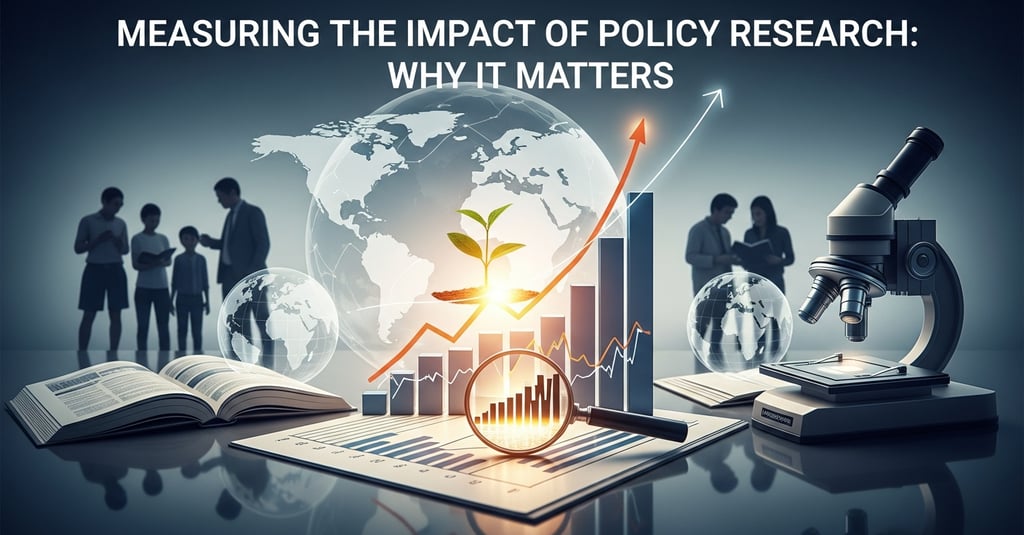
Measuring the Impact of Policy Research: Why It Matters
This blog explores why measuring the impact of policy research is essential for accountability, learning, and effective governance. It examines how research influence extends beyond direct policy adoption to shaping discourse, building capacity, and informing long-term decision-making. The article discusses approaches to assessing impact through policy engagement, public debate, and qualitative evaluation, while acknowledging the complexity of policy change. Emphasizing learning over narrow metrics, it argues that impact measurement helps research institutions refine strategies, strengthen trust, and align work with public value. Ultimately, the blog presents impact assessment as vital to ensuring that policy research meaningfully contributes to informed, inclusive, and responsive governance.
11/3/20254 min read
Policy research plays a vital role in shaping public decisions, informing debate, and guiding institutional reform. Governments, civil society organizations, and international bodies increasingly rely on research to navigate complex social, economic, and environmental challenges. Yet, despite its growing prominence, a fundamental question often remains unanswered: how do we know whether policy research is actually making a difference? Measuring the impact of policy research is not merely an administrative exercise; it is essential for accountability, learning, and the effective use of knowledge in governance.
From Knowledge Creation to Public Value
Policy research is ultimately justified by its contribution to public value. While producing rigorous analysis is a necessary first step, research achieves its purpose only when it influences understanding, decision-making, or outcomes. Measuring impact helps trace this journey from knowledge creation to social relevance. It asks whether research has informed policy debates, shaped institutional practices, or contributed to improved outcomes for communities.
One of the challenges in measuring impact lies in the nature of policy change itself. Policy processes are complex, non-linear, and influenced by multiple actors and factors. Research rarely leads directly to a single policy decision; instead, it contributes incrementally by shaping ideas, framing debates, and informing options. Recognizing this complexity is essential for meaningful impact assessment. Simplistic metrics that focus solely on immediate policy adoption risk underestimating the broader and longer-term influence of research.
Impact measurement also reinforces accountability. Policy research is often supported by public or philanthropic resources, creating an obligation to demonstrate value beyond academic outputs. By assessing impact, research institutions can show how their work contributes to public understanding, institutional learning, and policy improvement. This transparency strengthens trust among funders, policymakers, and the public.
Importantly, measuring impact does not imply reducing research to utilitarian outcomes alone. Conceptual contributions—such as introducing new frameworks, reframing issues, or challenging assumptions—are often precursors to tangible change. Impact assessment should therefore capture both instrumental effects, such as policy reform, and conceptual effects, such as shifts in discourse and understanding.
Evidence of Influence: Approaches to Assessing Policy Research Impact
Assessing the impact of policy research requires a combination of qualitative and quantitative approaches. Traditional academic metrics, such as citations, provide some indication of scholarly influence but are insufficient for capturing policy and societal impact. Broader approaches consider how research is used, discussed, and integrated into decision-making processes.
One important dimension of impact is policy engagement. Evidence that research has informed policy documents, legislative debates, advisory committees, or program design suggests meaningful influence. Tracing such connections often involves documenting interactions with policymakers, references in official reports, or participation in consultative processes. While these links may not establish causality, they indicate pathways through which research contributes to governance.
Another dimension is public discourse. Policy research that shapes media coverage, public debate, or civil society advocacy demonstrates impact beyond formal institutions. Op-eds, public lectures, media citations, and digital engagement are indicators of how research reaches and informs broader audiences. In democratic contexts, such discourse-related impact is particularly valuable, as it strengthens informed participation and accountability.
Capacity building represents a further area of impact. Research institutions often contribute by training policymakers, students, and practitioners, enhancing their ability to engage with evidence. Evaluating training outcomes, skill development, and institutional learning helps capture this less visible but highly significant form of impact. Strong policy systems depend not only on research outputs but also on the people who can interpret and apply them.
Qualitative methods, such as case studies and interviews, are especially useful for understanding impact in context. They allow researchers to explore how evidence is perceived, adapted, and used over time. Such methods capture nuance and complexity that quantitative indicators may miss. Combining these approaches provides a more comprehensive picture of research influence.
However, impact measurement also faces risks. Overemphasis on measurable outcomes can incentivize short-term or superficial engagement at the expense of deeper, long-term research. Effective impact assessment must therefore balance rigor with flexibility, recognizing that meaningful policy change often unfolds over extended periods.
Learning, Accountability, and the Future of Policy Research
Measuring the impact of policy research is not only about demonstrating success; it is also about learning. Impact assessment provides feedback that helps research institutions refine strategies, improve relevance, and strengthen engagement. By understanding what works and what does not, institutions can allocate resources more effectively and enhance future contributions.
Impact measurement also supports ethical responsibility. Research that aims to inform policy must be attentive to whose interests it serves and whose voices it amplifies. Evaluating impact can reveal whether research reaches marginalized communities, addresses inequality, or reinforces existing power structures. This reflection helps align research practice with values of inclusion and social justice.
For policymakers, impact-aware research enhances trust. When research institutions are transparent about their influence and limitations, they foster more honest and productive collaboration. Policymakers benefit from understanding how evidence has shaped past decisions and where gaps remain. This shared learning strengthens evidence-based governance.
Institutional culture plays a critical role in sustaining meaningful impact measurement. Research organizations must value engagement, reflection, and communication alongside academic excellence. Incentive structures, evaluation criteria, and leadership commitment all influence whether impact assessment becomes a genuine learning tool or a bureaucratic requirement.
Ultimately, measuring the impact of policy research matters because it closes the loop between knowledge and action. It ensures that research remains connected to societal needs and responsive to changing contexts. In a world facing complex and urgent challenges, the effectiveness of policy research cannot be assumed; it must be examined, learned from, and continuously improved. By embracing thoughtful impact measurement, policy research can strengthen its contribution to informed governance, democratic accountability, and public good.