Policy Challenges and Opportunities in 2025: A Year of Transition and Transformation
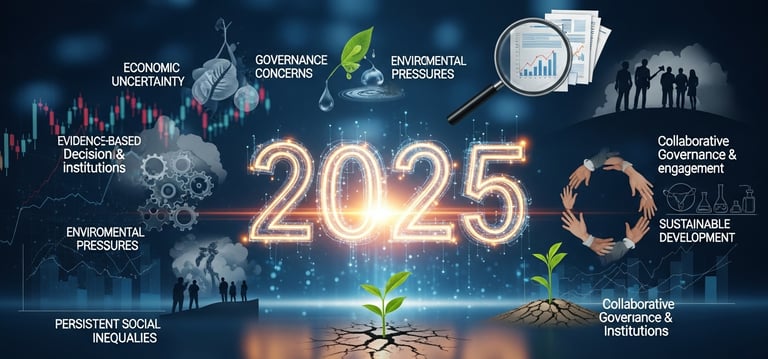
This blog reflects on the key policy challenges and opportunities that shaped the year 2025, a period marked by economic uncertainty, governance concerns, digital transformation, environmental pressures, and persistent social inequalities. It examines how these challenges tested existing policy frameworks while also creating space for evidence-based decision-making, collaborative governance, and sustainable development. The article highlights the growing role of research institutions, data-driven policies, and inclusive engagement in addressing complex societal issues. Overall, it presents 2025 as a transformative year that reinforced the importance of informed, research-led policy-making for resilient and equitable governance.
1/1/20254 min read
Introduction
The year 2025 marked a significant period of transition in global and national policy landscapes. Governments, institutions, and societies across the world navigated complex challenges shaped by economic uncertainty, rapid technological change, environmental pressures, and evolving democratic expectations. At the same time, 2025 also presented important opportunities for policy reform, innovation, and collaboration grounded in evidence-based decision-making.
For policy research institutions such as the Institute of Policy Research and Studies (IPRS), 2025 underscored the growing importance of rigorous research, informed dialogue, and inclusive policy engagement. This blog reflects on the key policy challenges faced during the year and highlights the emerging opportunities that can shape more resilient, equitable, and sustainable governance in the years ahead.
Key Policy Challenges in 2025
1. Economic Uncertainty and Inclusive Growth
One of the most pressing challenges of 2025 was managing economic uncertainty while ensuring inclusive growth. Many economies continued to face the aftereffects of global disruptions, including inflationary pressures, employment instability, and uneven recovery across sectors and regions.
Policymakers struggled to balance fiscal discipline with social protection, particularly for vulnerable populations. Questions around public spending, welfare delivery, and employment generation remained central to policy debates. The challenge lay not only in restoring growth but in ensuring that growth translated into broad-based social and economic benefits.
2. Governance, Trust, and Institutional Credibility
A recurring policy concern in 2025 was declining public trust in institutions. Citizens increasingly demanded transparency, accountability, and responsiveness from governments. Weak governance structures, bureaucratic inefficiencies, and gaps in service delivery often undermined policy outcomes.
The year highlighted the need for governance reforms that strengthen institutions, improve administrative capacity, and enhance citizen engagement. Policy responses that lacked credibility or public consultation frequently faced resistance, emphasizing the importance of participatory and evidence-informed governance.
3. Digital Transformation and Regulatory Gaps
The rapid pace of digital transformation posed both opportunities and regulatory challenges in 2025. Governments expanded the use of digital platforms in public service delivery, data management, and communication. However, this progress also raised concerns related to data privacy, cybersecurity, misinformation, and digital exclusion.
Policy frameworks often struggled to keep pace with technological advancements. Ensuring equitable access to digital infrastructure, protecting citizens’ rights, and regulating emerging technologies became key governance challenges requiring informed and adaptive policy responses.
4. Environmental Sustainability and Climate Policy
Environmental concerns continued to dominate policy discussions in 2025. Climate change, resource depletion, and environmental degradation increasingly affected economic stability, public health, and social cohesion. Despite growing awareness, translating environmental commitments into effective policy action remained a significant challenge.
Many governments faced difficulties aligning short-term economic priorities with long-term sustainability goals. Weak implementation mechanisms, limited financing, and fragmented policy approaches hindered progress, underscoring the need for integrated and evidence-based environmental policies.
5. Social Inequality and Access to Opportunities
Persistent social inequalities remained a major policy challenge throughout 2025. Issues related to education, healthcare access, gender equality, and regional disparities required sustained policy attention. In many contexts, policy interventions failed to adequately address structural inequalities, resulting in uneven outcomes.
The year reinforced the importance of designing policies that are inclusive, context-sensitive, and informed by reliable data. Without targeted interventions and continuous evaluation, social policies risked reinforcing existing disparities rather than reducing them.
Emerging Policy Opportunities in 2025
Despite these challenges, 2025 also offered important opportunities for policy innovation and reform.
1. Strengthening Evidence-Based Policy-Making
One of the most significant opportunities in 2025 was the growing recognition of evidence-based policy-making. Policymakers increasingly relied on research, data analysis, and expert input to design and evaluate policies. This shift created space for research institutions, universities, and think tanks to play a more influential role in shaping public decisions.
By integrating research insights into policy design, governments were better positioned to develop targeted, effective, and adaptable interventions. This trend reinforced the relevance of policy research institutions committed to academic rigor and practical impact.
2. Collaborative Governance and Multi-Stakeholder Engagement
2025 saw renewed emphasis on collaboration across sectors. Governments, civil society organizations, academic institutions, and the private sector increasingly engaged in dialogue and partnerships to address complex policy issues.
Multi-stakeholder approaches proved particularly valuable in areas such as climate action, urban governance, and social welfare. These collaborations demonstrated that inclusive policy processes—when supported by credible research—can enhance legitimacy and effectiveness.
3. Policy Innovation Through Digital Tools
While digital transformation posed regulatory challenges, it also offered opportunities for policy innovation. Data analytics, digital service platforms, and technology-enabled monitoring systems enhanced policy implementation and evaluation.
In 2025, several policy initiatives benefited from improved data collection and real-time feedback mechanisms. These tools enabled policymakers to assess outcomes more effectively and adjust strategies based on evidence rather than assumptions.
4. Renewed Focus on Sustainable Development
Sustainable development gained renewed momentum as policymakers increasingly recognized the interconnectedness of economic growth, social inclusion, and environmental protection. In 2025, sustainability considerations were more frequently integrated into development planning and policy frameworks.
This shift created opportunities for long-term policy thinking and research-driven solutions that balance immediate needs with future resilience. Institutions engaged in sustainability-focused research played a crucial role in informing these efforts.
5. Capacity Building and Youth Engagement
Another positive development in 2025 was growing attention to capacity building and youth participation in policy processes. Students, young researchers, and early-career professionals increasingly engaged in research initiatives, policy dialogues, and academic forums.
This trend highlighted the importance of nurturing the next generation of policy thinkers and leaders. Investing in research training, academic mentorship, and inclusive platforms emerged as a key opportunity for strengthening policy ecosystems.
Reflections for Policy Research Institutions
For institutions like the Institute of Policy Research and Studies, the policy landscape of 2025 reaffirmed the importance of their role in society. The year demonstrated that policy challenges are increasingly complex, interconnected, and data-intensive. Addressing them requires sustained research, interdisciplinary collaboration, and effective communication between researchers and decision-makers.
Policy research institutions are uniquely positioned to:
Generate credible and context-specific evidence
Facilitate informed dialogue among stakeholders
Translate research into accessible policy insights
Support inclusive and sustainable policy reform
By strengthening these functions, research institutions can contribute meaningfully to better governance and social outcomes.
Conclusion
The year 2025 was marked by significant policy challenges, but it also opened pathways for innovation, collaboration, and reform. Economic uncertainty, governance deficits, digital transformation, environmental pressures, and social inequality tested existing policy frameworks. At the same time, growing recognition of evidence-based policy-making, collaborative governance, and sustainability created opportunities for positive change.
As we reflect on 2025, one lesson stands out clearly: effective public policy must be grounded in credible research, inclusive engagement, and long-term thinking. These principles remain central to the mission and vision of the Institute of Policy Research and Studies as it continues its work in advancing informed policy-making and community engagement.