Public Policy and Sustainable Development: What Needs to Change?
This blog examines the critical relationship between public policy and sustainable development, arguing that meaningful change requires more than rhetorical commitments. It explores why existing policies often fail to deliver sustainable outcomes, highlighting issues such as fragmented governance, short-term political thinking, and weak implementation. The article calls for integrated, evidence-based, and inclusive policy approaches that balance economic growth with social equity and environmental protection. Emphasizing institutional reform, accountability, and long-term responsibility, the blog concludes that sustainable development can only be achieved when public policies are designed and implemented with coherence, participation, and future generations firmly in mind.
4/1/20254 min read
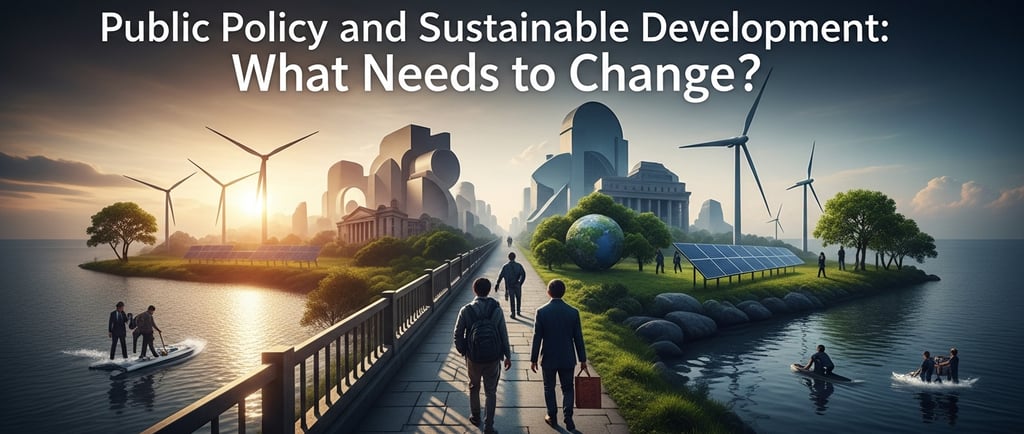
Sustainable development has become one of the most frequently used terms in contemporary policy discourse. Governments, institutions, and international organizations regularly invoke sustainability in development plans, policy frameworks, and public commitments. Yet, despite this widespread recognition, the gap between sustainability goals and actual policy outcomes remains significant. The challenge today is not a lack of awareness, but the need for meaningful changes in how public policies are designed, implemented, and evaluated in order to achieve truly sustainable development.
Beyond Commitments: Understanding the Policy–Sustainability Gap
Public policy plays a decisive role in shaping development trajectories. Economic growth, social welfare, environmental protection, and institutional resilience are all deeply influenced by policy choices. However, many existing policy frameworks continue to treat sustainability as an add-on rather than a guiding principle. Development strategies often prioritize short-term economic gains while postponing environmental and social considerations for the future.
One of the core issues lies in fragmented policy-making. Economic, social, and environmental policies are frequently developed in isolation, managed by separate institutions with limited coordination. This compartmentalized approach undermines sustainability, which by definition requires integrated and long-term thinking. For instance, infrastructure policies may promote rapid urban expansion without adequate consideration of environmental impact, public health, or social equity. Similarly, economic policies may encourage industrial growth while overlooking resource depletion and ecological stress.
Another challenge is the dominance of short political cycles. Elected governments often operate under pressure to deliver immediate results, making it difficult to invest in policies whose benefits will materialize over decades rather than years. Sustainable development, however, requires patience, continuity, and long-term vision. When policy success is measured primarily through short-term indicators, sustainability goals are easily sidelined.
In addition, sustainability policies often suffer from weak implementation. While many governments adopt sustainability-oriented frameworks, their translation into actionable programs is uneven. Limited institutional capacity, inadequate financing, and insufficient monitoring mechanisms reduce the effectiveness of such policies. Without clear accountability structures, sustainability commitments risk becoming symbolic rather than transformative.
Rethinking Public Policy for Sustainable Futures
Achieving sustainable development requires a fundamental rethinking of how public policies are conceived and executed. The first change must be a shift from sectoral to integrated policy-making. Sustainable development cannot be achieved through isolated interventions; it demands coherence across economic, social, and environmental domains. Public policies must be designed to recognize interdependencies and manage trade-offs explicitly rather than ignoring them.
Evidence-based policy-making is central to this transformation. Sustainable development policies must be grounded in reliable data, scientific research, and contextual analysis. This includes understanding environmental thresholds, social vulnerabilities, and long-term economic impacts. Policies based on incomplete or outdated information are unlikely to deliver sustainable outcomes. Continuous research, evaluation, and learning should therefore be embedded within policy processes.
Another critical change involves inclusivity and participation. Sustainable development is not merely a technical challenge; it is a social and political one. Communities, particularly those most affected by environmental degradation and social inequality, must be involved in shaping development policies. Inclusive policy processes enhance legitimacy, improve problem identification, and ensure that sustainability strategies reflect local realities rather than abstract models.
Public policy must also move beyond growth-centric development narratives. While economic growth remains important, sustainability requires redefining progress to include social well-being, environmental resilience, and quality of life. Indicators of development should reflect these broader goals rather than focusing narrowly on economic output. Policies that prioritize growth at the expense of ecological stability or social cohesion ultimately undermine long-term development.
Institutional reform is another area where change is essential. Sustainable development requires strong, adaptive institutions capable of coordination, regulation, and long-term planning. This includes strengthening environmental governance, enhancing regulatory frameworks, and building administrative capacity at all levels. Institutions must be empowered to enforce sustainability standards and adapt policies as conditions evolve.
Finally, accountability and evaluation mechanisms must be strengthened. Sustainable development policies should be subject to regular monitoring and transparent reporting. Clear benchmarks and performance indicators allow policymakers and the public to assess whether policies are delivering intended outcomes. Without accountability, sustainability risks becoming a rhetorical commitment rather than a measurable objective.
Aligning Policy, Responsibility, and Long-Term Impact
The path toward sustainable development depends on aligning public policy with long-term responsibility. This alignment requires acknowledging that current policy choices shape future possibilities. Environmental degradation, social exclusion, and institutional weakness are not inevitable outcomes; they are often the result of policy decisions that prioritize short-term gains over long-term resilience.
Changing public policy for sustainable development also requires cultural and normative shifts. Policymakers must view sustainability not as a constraint on development, but as its foundation. Long-term thinking, precautionary approaches, and ethical responsibility toward future generations should guide policy decisions. This shift challenges conventional governance practices but is essential for addressing twenty-first-century challenges.
Policy research institutions play a crucial role in this process by generating knowledge, facilitating dialogue, and evaluating policy outcomes. By providing evidence-based insights and fostering informed debate, such institutions help bridge the gap between sustainability ideals and policy realities. They also support capacity building and encourage collaboration across sectors and stakeholders.
Ultimately, sustainable development is not achieved through isolated policies or declarations. It emerges from consistent, coherent, and inclusive policy frameworks that balance economic, social, and environmental objectives over time. What needs to change is not the aspiration for sustainability, but the depth of commitment, the quality of policy design, and the willingness to prioritize long-term public interest over short-term expediency. Only then can public policy become a genuine driver of sustainable and equitable development.