The Role of Public Discourse in Shaping Policy Outcomes
This blog explores the critical role public discourse plays in shaping policy outcomes in democratic societies. It examines how debate, media narratives, expert input, and civic engagement influence agenda-setting, policy legitimacy, and implementation. The article highlights the interaction between discourse and power, noting how unequal access and misinformation can distort policy decisions. Emphasizing the importance of informed and inclusive conversation, it argues that healthy public discourse strengthens governance by improving trust, accountability, and compliance. Concluding that discourse is an integral part of the policy process, the blog underscores the need for evidence-based communication and active citizen engagement to achieve effective and democratic policy outcomes.
10/7/20254 min read
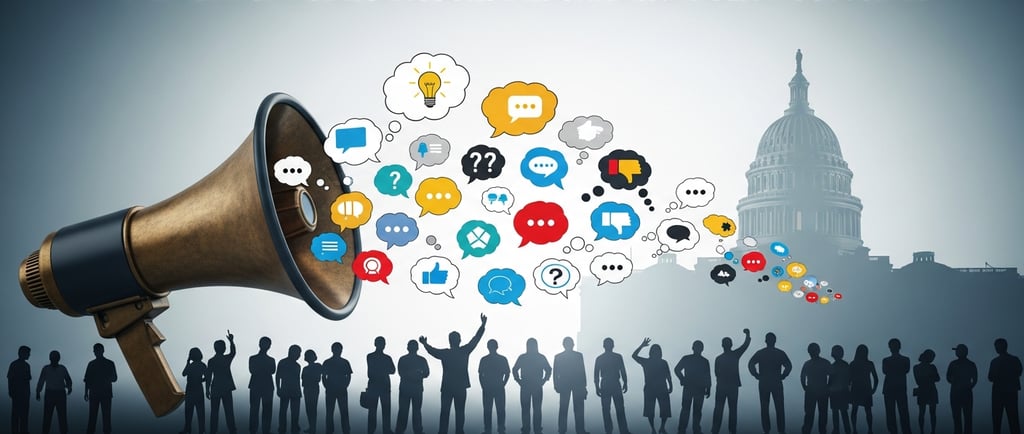
Public policy does not emerge solely from expert analysis, institutional procedures, or legislative authority. It is also shaped by conversations that take place in public spaces—through media, civic forums, academic debate, community engagement, and everyday political discussion. In democratic societies, public discourse functions as a powerful force that influences how problems are defined, which solutions are considered legitimate, and how policy outcomes are ultimately received. Understanding the role of public discourse is therefore essential to understanding how policy is made, contested, and transformed.
When Ideas Enter the Public Arena
Public discourse refers to the exchange of ideas, arguments, and perspectives among citizens, institutions, and opinion-shapers on matters of public concern. This discourse plays a foundational role in policy-making because it shapes the way issues are framed long before formal decisions are taken. How a problem is discussed publicly—whether as an economic challenge, a moral issue, a security threat, or a matter of rights—strongly influences the policy responses that follow.
Policy agendas are rarely neutral. Issues rise or fall in importance based on public attention, media narratives, and political debate. Public discourse helps determine which issues are seen as urgent and which are ignored. For example, sustained public discussion around inequality, environmental degradation, or public health can push these concerns onto policy agendas, compelling governments to respond. In this way, discourse acts as a gateway between social experience and institutional action.
Public discourse also shapes legitimacy. Policies that are introduced without prior discussion or public understanding often face resistance, even when technically sound. Conversely, policies that emerge from open debate are more likely to be perceived as legitimate, even when they involve difficult trade-offs. Discourse allows citizens to understand the rationale behind decisions and to see their concerns reflected in policy narratives.
Importantly, public discourse is not limited to formal political debate. It includes academic commentary, civil society advocacy, cultural expression, and increasingly, digital communication. These diverse channels contribute to a pluralistic policy environment where ideas compete and evolve. In democratic contexts, this competition is not a weakness but a strength, provided it is grounded in reasoned argument and access to credible information.
Debate, Power, and the Making of Policy Meaning
While public discourse has the potential to enrich policy-making, it is also shaped by power relations. Not all voices carry equal weight, and not all perspectives receive equal visibility. Media access, institutional authority, economic resources, and social status influence whose arguments dominate public debate. Understanding this dynamic is crucial for assessing how discourse shapes policy outcomes.
Media plays a particularly influential role in framing policy issues. Through selection of topics, language, and emphasis, media narratives can amplify certain perspectives while marginalizing others. These narratives influence public perception and political incentives, shaping how policymakers interpret public opinion. In this sense, policy outcomes are often responses not to objective reality alone, but to perceived public sentiment shaped through discourse.
Public discourse also interacts with expertise. Research evidence and expert analysis enter the public arena through reports, commentary, and public engagement. When communicated effectively, evidence can elevate the quality of debate and support informed decision-making. However, when expertise is misrepresented, oversimplified, or politicized, discourse can become polarized and detached from evidence. This tension highlights the importance of responsible communication and research integrity in public debate.
Civil society organizations and advocacy groups contribute to discourse by articulating social concerns and mobilizing public support. Their role is particularly important in representing marginalized voices that may otherwise be excluded from policy discussions. Through sustained engagement, advocacy can reshape policy narratives and expand the range of acceptable policy options.
Public discourse also affects policy implementation. Even well-designed policies can falter if they lack public understanding or support. Discourse influences compliance, cooperation, and trust. When policies are communicated transparently and debated openly, citizens are more likely to engage constructively. Conversely, when discourse is dominated by misinformation or distrust, policy effectiveness is undermined.
Toward Informed and Inclusive Policy Conversations
The quality of public discourse matters as much as its existence. Informed policy outcomes depend on discourse that is inclusive, evidence-aware, and respectful of complexity. Simplistic narratives, misinformation, and polarized debate can distort policy choices and weaken governance. Strengthening public discourse is therefore a governance challenge in its own right.
Institutions have a responsibility to contribute to healthier discourse. Governments must communicate policies clearly and transparently, explaining both benefits and limitations. Research institutions and think tanks play a vital role by translating complex analysis into accessible insights without sacrificing rigor. Media organizations bear responsibility for accurate reporting and balanced representation of perspectives.
Citizen engagement is equally important. Democracies function best when citizens are informed participants rather than passive consumers of information. Education, media literacy, and opportunities for deliberation strengthen the capacity of citizens to engage critically with policy debates. Such engagement reduces vulnerability to misinformation and enhances the legitimacy of policy outcomes.
Digital platforms have transformed public discourse, expanding access and participation while also creating new challenges. Speed, amplification, and algorithmic influence can intensify polarization and spread falsehoods. Addressing these challenges requires a combination of regulation, platform responsibility, and public awareness. Digital discourse must be integrated into democratic norms rather than allowed to undermine them.
Ultimately, public discourse is not separate from policy-making; it is part of the policy process itself. It shapes agendas, legitimizes decisions, and influences outcomes. Policies that ignore discourse risk failure, while those that engage constructively with public debate are more likely to endure. By fostering informed, inclusive, and evidence-based discourse, societies can strengthen democratic governance and improve policy outcomes in an increasingly complex world.